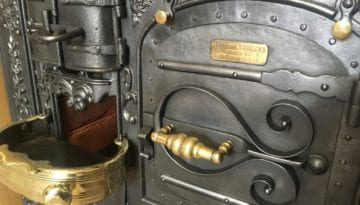
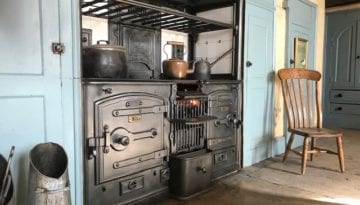
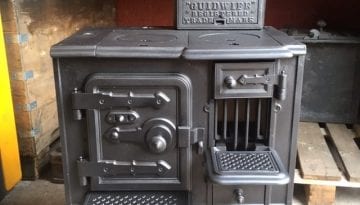
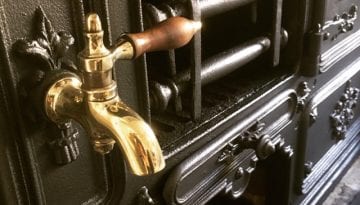
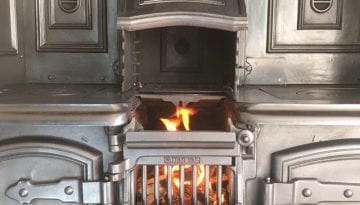
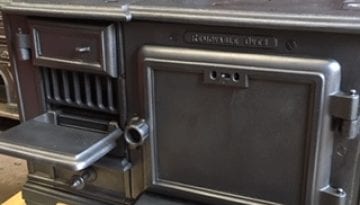
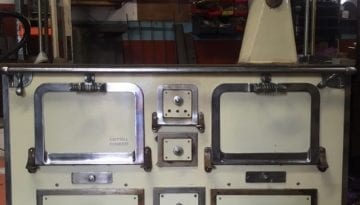
This very nice example a Yorkshire actually resides in Northamptonshire. We were called out to to survey the range, remove an unwanted back boiler, rebuild the firebox and brick flue above, decommission the oven flue and then give the whole range a good polish. I’m pleased to say it draws well and certainly looks the part. The owners are thrilled and so is King the Vizsla.
Category: cast iron range
-

A Yorkshire Range in Northamptonshire
-

A beautiful Cornish Range for sale!
It is a rare moment when we get time out from restoring clients ranges to work on one of our own and offer it for sale. I’ve been wanting to restore this Cornish Range for a long time now and I had that opportunity a few weeks ago. So here it is, a fantastic example of a Cornish Range, heavily ornamented castings and covered in polished brass. This one also comes complete with a bespoke pine surround and drying rail to complete the picture.If you are interested in this range just send us an email using the information on the contact page of this site
-

Work complete at Cogges Manor Farm museum
We were delighted to return the kitchen range to the kitchen of the fantastic Cogges Manor Farm museum this week. The range was in a terrible state when we first carried out the site survey but now it has been fully restored and will be ready for service for many more years to come.This range is in weekly use for demonstrations and for school eduction. If you are in the Oxford area please do plan a visit to Cogges, its a truly fantastic place!
The range is a large close fire type called a Swinton and manufactured by Hattersley Bros. Ltd at their Queen’s foundry, Swinton near Rotherham. This particular example was badge engineered as a Mortimer and supplied by Bratt Colbran & Co from their London showrooms on (you guessed it!) Mortimer Street.
-

Why we welcome the UK coal ban, our environmental ethos and sustainability through solid fuel.
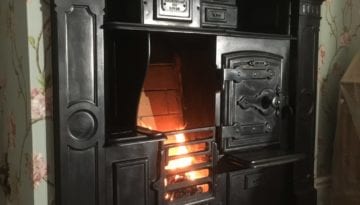
The use of coal
We are passionate about sustainability, and our environmental impact.
You might roll your eyes at that statement, and rightly equate the kitchen ranges we so adore with the polluting use of filthy house coal. But hear us out for just a minute… appearances can be deceiving! We’ve had many years of pondering and problem solving this, so we may conduct the conservation work that we love and believe in, without the cost to our conscience.
We warmly welcome the introduction of the domestic ban on house coal and wet wood, which comes into effect in February 2021, but there’s been a lot that is misleading in the coverage of this ban in the media. The use of smokeless coal and appropriately dried wood is still permitted. We personally only use kiln dried wood and an occasional scoop of smokeless. Which is what we advise all of our customers.
In reality the ban is nothing new and most cities have long had a ban on the use of house coal – starting with London’s clean air act of 1956. House coal is one of the dirtiest fuels for local air quality – with 9.14g per tonne of particulate matter produced according to DEFRA. As a couple of people who spend an unreasonable amount of time up chimneys and cleaning out the flues of victorian ranges, we can attest that house coal is disgusting stuff. If you’ve seen Olly after a days work, you’ll know what I mean.
Ironically, at the same time as introducing a domestic ban on the use of house coal, our government has given the go ahead to the UKs first deep coal mine in decades. We are slowly moving away from coal powering our national grid, but its replacement has been gas, not the renewable and achievable alternatives of wind and solar power. We believe that to meet the emissions targets more needs to be in place to limit industrial and aviation emissions rather than the responsibility being disproportiantly placed on the individual.
The ban on burning wet wood should, hopefully, stop the selling and burning of unseasoned wood which has by far the highest particulate rating of 30.28. It is an incredibly inefficient fuel, and causes terrible build up of tar and pitchmen in the flues of your range/stove and chimney. If you’re not already burning kiln dried or well seasoned wood with a moisture level less than 12%, you should be, dried wood is said to be carbon neutral, and you’ll see the difference in the performance of your appliance.
The ban does not encompass smokeless fuels – these are much cleaner in terms of particulate emissions. Anthracite (naturally occurring smokeless coal), has a rating of 1.84, less than 1/4 that of even kiln dried wood. This is a mined fossil fuel however, so the particulate emissions are by no means the whole story here, but if you chose to run your appliance on it, this represents a much cleaner version of coal which is legal to burn throughout the UK. Another form of smokeless fuel is manufactured briquettes which are formed of anthracite dust, a by-product of mining, bound together with molasses. These fuels have an even lower particulate rating than anthracite, and are therefore the most desirable to use, aside from dried wood. There are many ‘eco’ versions now on the market, which replace up to 50% with sawdust or other waste products. We are always mindful of these products, keeping an eye on their heat output and the quantities burned. Sometimes it’s a false economy to use them if you’re burning double as much of the ‘eco’ version, you’re burning the same amount of anthracite dust!
Around 86% of UK homes are heated by a gas boiler, which produces 60% less CO2 than coal and far less particulate air pollution. However, as the National Geographic reported this week, the gas mining and fracking industry has a serious impact on methane emissions in the atmosphere, it’s not just cows that are a problem when it comes to methane! Because, for most people, our power is supplied through the national grid, we have the luxury of being removed from the realties of our fuel consumption, not getting our own hands dirty. But it begs the question whether the most environmentally concious heating choice, on a budget, is in fact a dried wood fire?
Other earth friendly options include very expensive but well received heat pumps, biomass boilers which burn wood pellets, and of course if you can generate enough of your own solar energy to power electric radiators or an electric boiler, but most of these options are simply unaffordable for your average UK household.
What do we use?
Well, we don’t have a range, yet! We live on a boat and don’t have central heating, so all our heat comes from our solid fuel stove, which we run on kiln dried hard wood logs. As such we’re off grid, and our power is solar. In the workshop, our electricity contract has always been with Green Energy, a South West company which matches the electricity we use from the national grid with sustainable energy from South West wind and solar, putting this back into the grid.
Our work van is a modern diesel, as there are no realistic options at the current time but we eagerly await an affordable electric van which can go the distance!
What about manufacture?
“Our ethos is that if something is built to a high specification in the first instance then it will have not only have a long service life but it can be repaired if required. For this reason, we believe ‘built to last’ should be the mantra of anyone serious about sustainability in manufacture.”
Oliver Osborne
Metals of all types are almost infinitely recyclable. We use 100% recycled iron and brass for our castings, specially selected by the foundryman for its quality. Coupled with the craft of the foundryman it follows that the castings we produce are of exceptional quality and will last for generations to come. The remelting of existing iron and yellow metal stocks uses dramatically less energy than its manufacture from first principles.
The fact is the ranges, stoves and grates we work with already exist, and we believe passionately in preserving what’s left of our domestic heritage for future generations, and in understanding more of our ‘below stairs’ history. At present, these are not listed as protected artefacts, and therefore have disappeared at an alarming rate. We’re committed to conserving and restoring what’s left for posterity.
There are some regrettable uses of packaging and non-recyclables in our workshops, for instance the use of sealants and resins for casting when pattern making. We continue to strive to find alternatives, but in the mean time we keep pretty low usage.
We do receive a lot of postage materials like bubble wrap and jiffy bags, which come from sub-contractors and suppliers. If you’ve ever received post from us, you’ll know well enough that we reuse this and use paper tape – it’s not always the prettiest parcel, but it gets reused to within an inch of it’s life and we’ve never bought a roll yet!
One difficulty is when palletising a range for shipping, we need to wrap it in polythene wrap to keep all the moving parts secure and protect the surface. This is the bain of my life – if anyone knows of a bio-degradable wrap, please send recommendations my way!
When on site fitting a range, we only use Lime in our installations. Lime creates 20% less CO2 than Portland cement in its manufacture and unlike cement absorbs CO2 whilst setting so is close to carbon neutral. Portland cement is used on request when required for historical purposes.

-

Patterns, Patterns, Patterns…
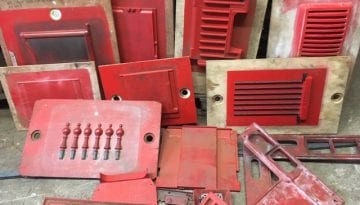
We’ve just been up the foundry today to drop off this batch of these traditionally wooden green sand patterns, all for upcoming jobs in the next few months!
-

Self acting cottage range at Little Tew Manor
This is the other range that we restored for Lisa Shell Architects at Little Tew Manor. This basic but beautiful self acting cottage range is in an adjacent room to the main kitchen and would have provided the cooking duties, hot water and warmth for the staff.
It was in a terrible state of repair when we first visited site to make the initial assessment and had obviously seen lots of use over the years. With careful conservation techniques we were able to bring the range back to presentable order whilst retaining its history. This range will now be the focal point in a new office but will not be used.
-

The Herald Range at Little Tew Manor
‘The Herald Range’ is one of two ranges we restored for our clients at Little Tew Manor. The Herald Range would have provided all the cooking services for the main household while the smaller ‘Cottage Range’ would have cooked for the staff.
The Herald Range was in a hell of state when we first visited site for the assessment but with careful conservation practice we were able to preserve the range for future generations.
Below are the before and after shots of the work
-

Belle Portable restored
Here we have a Belle Portable dating from circa 1920. These ranges were manufactured by Jones & Campbell in there thousands and were the companies most popular line throughout much of the early 20th century.
This one has been painstakingly restored and is now ready to go back home where we have been assured it will be in daily use!
-

Crittall Cooker in stock
We recently acquired this fantastic Crittall Cooker. It dates from the 1930s and is quite unlike any other cooking apparatus common to this country. I believe Richard Crittall & Co were working with a European manufacturers and badge engineering this cookers under there name.
The range boasts two ovens, two hot closets, a coal scuttle and a huge hot plate. It is of enameled steel construction with cast iron top plate and firebox, heavily lined with firebrick and cast and chrome plated mouldings and details. These ranges are exceptionally rare and would make for a stunning feature.
The Crittall Cooker is available as a decorative piece or fully working. We can also install this range for you if required.